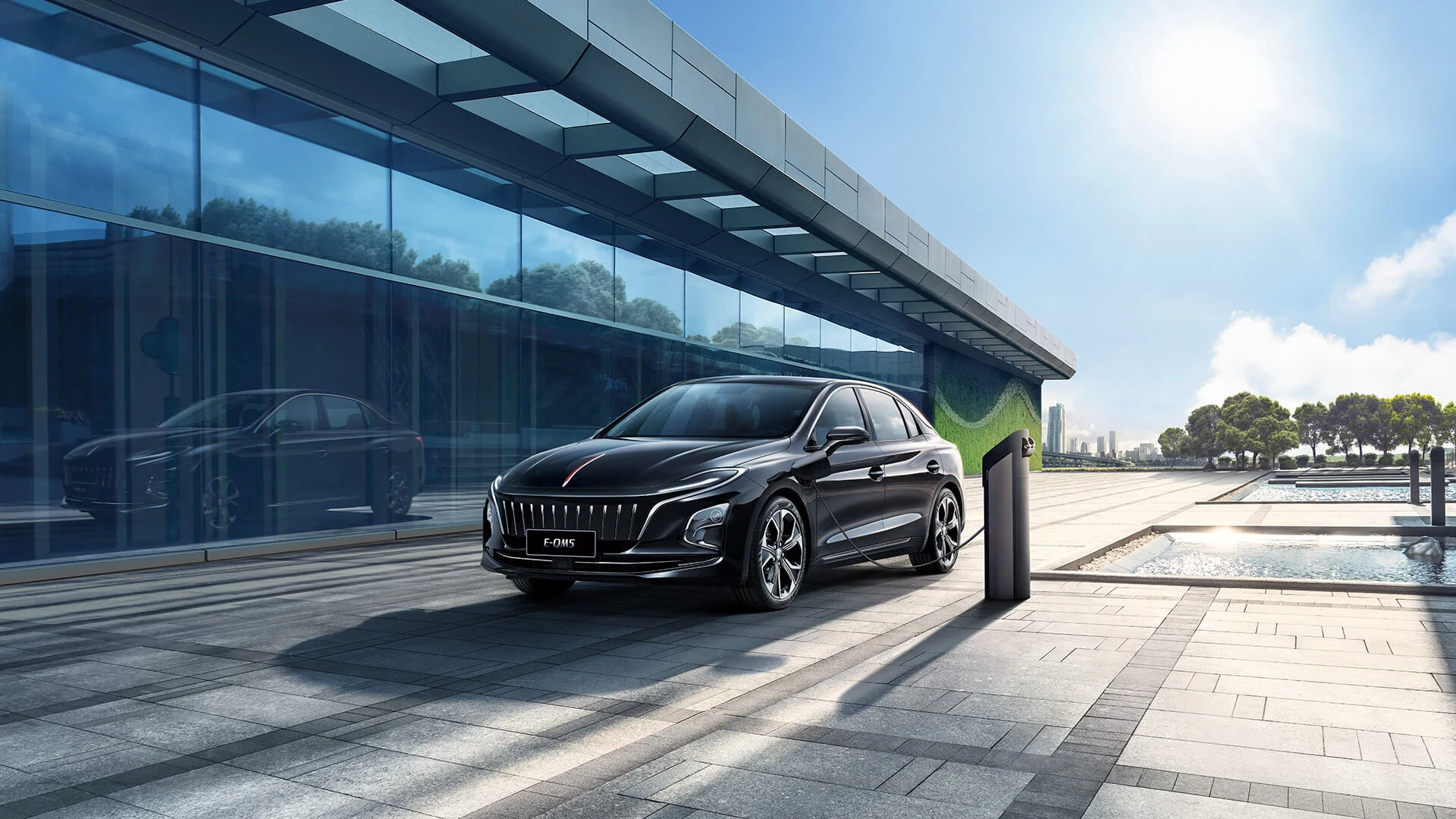
Can every E-QM5 charge from a home AC wallbox?
Do not assume that every E-QM5 has a conventional onboard AC charging arrangement. Hongqi’s global model reference describes AC use through external equipment connected to the DC side for the specification shown. That is a material buying question, not simply a matter of finding a cable that fits. Other years and versions need their own records.
Ask for inlet photographs, the vehicle specification and identification of any supplied conversion equipment. The charging compatibility guide covers the broader destination review. A seller should explain what the equipment does, which vehicle it supports and whether it is included in the offer.
Read the charge window before comparing minutes
A quoted 20–80% session is different from charging an almost empty battery to full. Hongqi’s global reference gives approximately 30 minutes for that stated window on its illustrated specification; it is not a promise for every E-QM5 or every public charger. Ask which battery and charging conditions the quotation describes.
The useful comparison is energy restored during the period your driver can actually stop. Include time to reach a charger, connect, authenticate and finish the session. A taxi schedule with short breaks can be affected by these additional minutes even when the car’s charging performance is satisfactory.
Use average power for an illustrative calculation
Charging energy divided by average delivered power gives a rough duration. For illustration only, adding 30 kWh at an average 45 kW takes about 40 minutes before other delays. These are chosen arithmetic inputs, not measured E-QM5 results. Using a charger’s advertised peak rating as the average would make the estimate look more optimistic.
The charging rate can change within the session. Ask for the energy actually delivered and elapsed time, not just a photograph of a high instantaneous reading. If energy is measured at the charger, do not describe it automatically as energy retained by the battery.
Request a session that can be assessed
A useful demonstration identifies the candidate, charger, date, starting and ending charge levels, duration and any warnings. Ambient conditions and whether the vehicle arrived after driving add important context. A brief plug-in video proves much less than a complete session record. Ask the inspector to explain gaps rather than fill them with assumptions.
Keep the result with the battery condition assessment. A successful charge is not a substitute for a battery-health test, and an unusually slow session does not by itself establish a defective battery. The charger or test conditions may need investigation.
Match the routine to the charging arrangement
For home-based buyers, establish how much energy must be restored overnight and whether the proposed equipment can support that routine. For fleet buyers, consider available bays, shift changes and whether several vehicles compete for the same supply. A single-car demonstration cannot prove that a depot will charge an entire batch within the desired window.
Have installation and equipment compatibility assessed by qualified local professionals. Do not promise that an adapter alone resolves differences in supply, communication or standards. If the arrangement is still uncertain, resolve it before choosing a version merely because it has a larger advertised battery.
Compare total charging cost, not only speed
A faster public session may cost more than a slower planned session, but the commercial result depends on tariffs, access and time. Record energy charges separately from parking, connection or idle fees. Use the electricity cost worksheet to keep charging expenditure distinct from dashboard consumption.
A dealer can compare two realistic routines without declaring one universally better. One customer may park near a suitable charger each night, while another needs a dependable daytime stop. The same vehicle can fit one routine and create avoidable disruption in the other.
What to include in a charging-time enquiry
Send the destination, intended charger or supply arrangement, daily distance and available charging window. State the accepted years and whether the request is for new, used or either condition. Ask for the original battery specification and a charging demonstration tied to the candidate. These details allow a meaningful discussion before equipment and vehicle costs are combined.
If a seller quotes an attractive time, ask whether it includes the external equipment your arrangement needs and whether the claimed window matches your use. Keep the answer in the offer. An unresolved charging requirement should remain visible rather than becoming an implied capability at handover.